
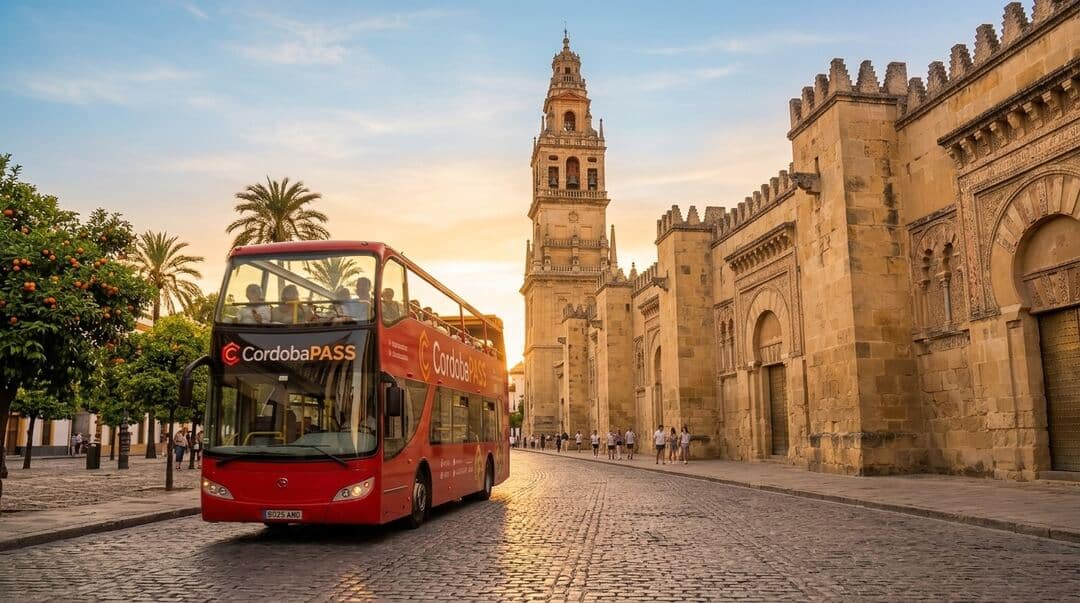
The Córdoba tourist bus covers the city with two complementary lines and around 20 physical stops between them, several of which are shared as connection points. With a single ticket you can hop on and off freely during its validity and see both the historic centre and the neighbourhoods and avenues around the edge. In this article we explain in detail which areas each line covers, what you can see on each one and how to combine them, and we include an interactive map of the areas and places the service passes through.
Book your Córdoba tourist bus ticket
The two tourist bus lines
The service, operated by City Sightseeing, is structured into two routes (operator data, checked on 19-11-2026):
- Blue Route, “Córdoba Íntima”: covers the historic centre and the city centre, with stops next to the Mosque-Cathedral, the Alcázar de los Reyes Cristianos and the Palacio de Viana. It is the line designed for the monuments of the centre.
- Red Route, “Córdoba Panorámica”: makes a wide loop around the city and links the bank of the Guadalquivir with the city wall, the Victoria gardens, the train and bus station and the northern neighbourhoods, such as Santa Marina and San Lorenzo.
Both lines share five connection stops (Panorámica del Río, Palacio de la Merced-Diputación, Realejo-San Andrés, Ayuntamiento-Templo Romano and Arco del Portillo), so you can switch from one to the other with the same ticket. Routes, stops and timetables are subject to the operator’s current operations; at present, stop 1 of the red line is merged with the blue line at the same point, according to the notice published on its website.
Areas covered by the Blue Route (Córdoba Íntima)
The Mosque-Cathedral and the Jewish Quarter
The monumental heart of Córdoba. From the Mosque-Cathedral stop you can walk in a few minutes to the great mosque and the maze of alleys of the Jewish Quarter, with the Calleja de las Flores, the Synagogue and the Casa de Sefarad. This is the area where it is worth allowing the most time.
The Alcázar and the bank of the Guadalquivir
Next to the Alcázar de los Reyes Cristianos and its gardens, the blue line also reaches the Panorámica del Río, the viewpoint over the Guadalquivir from which you can see the Roman Bridge and the Calahorra Tower.
San Pedro and the Realejo
Two stops in neighbourhoods with their own identity: the San Pedro stop leaves you next to its church, close to the Corredera, and the Realejo-San Andrés stop lets you get off in the middle of the neighbourhood to explore it on foot.
The Palacio de Viana and the northern Axerquía
The blue line has a stop next to the Palacio de Viana, known for its twelve patios, and it is the line that goes into the Axerquía, the part of the city that grew outside the first wall.
Palacio de la Merced, Roman Temple and Tendillas
The administrative and commercial axis: the Palacio de la Merced, a former convent that is now the seat of the Provincial Council; the Roman Temple next to the Town Hall; and Plaza de las Tendillas, the commercial hub of the city, dominated by the equestrian monument to the Gran Capitán, a work by Mateo Inurria from 1923.
Arco del Portillo
A 14th-century gate opened in a stretch of the city wall, which marks the passage between the monumental centre and the shopping centre.
Areas covered by the Red Route (Córdoba Panorámica)
Panorámica del Río and the Roman Bridge
The start of the red line is one of the most photographed sections: the bus runs along the Guadalquivir with views of the Roman Bridge, the Calahorra Tower and the skyline of the historic centre.
San Basilio and the patios
The Alcázar Viejo neighbourhood, known as San Basilio, is the most characteristic setting of the Córdoba Patios Festival, declared Intangible Cultural Heritage of Humanity.
Puerta de Almodóvar and the city wall
The medieval gate that gave access to the Jewish Quarter from the west, with a preserved stretch of the city wall.
Mercado de la Victoria
The first gastronomic market opened in Andalusia, housed since 2013 in a 19th-century wrought-iron building inside the Victoria gardens. A practical stop for lunch or tapas halfway round the route.
Gran Capitán
Avenida del Gran Capitán, one of the commercial axes of the city centre, with much of its shopping.
Train and bus station
The red line has a stop at the train (AVE) and bus station, which lets you connect the tourist bus with your arrival in the city, always subject to the service’s current timetables.
La Malmuerta and Santa Marina
The Malmuerta tower, an albarrana tower from the early 15th century, marks the entrance to the Santa Marina neighbourhood, with the church of the same name.
Corazón de María and San Lorenzo
Plaza del Corazón de María and the San Lorenzo neighbourhood continue the route through the Axerquía. The church of San Lorenzo, built after the Christian conquest on top of a former mosque, is another of the city’s Fernandine churches.
Caliphal Baths
Before closing the circle, the red line passes next to the Baths of the Caliphal Alcázar, the 10th-century Arab baths that can now be visited next to the Alcázar.
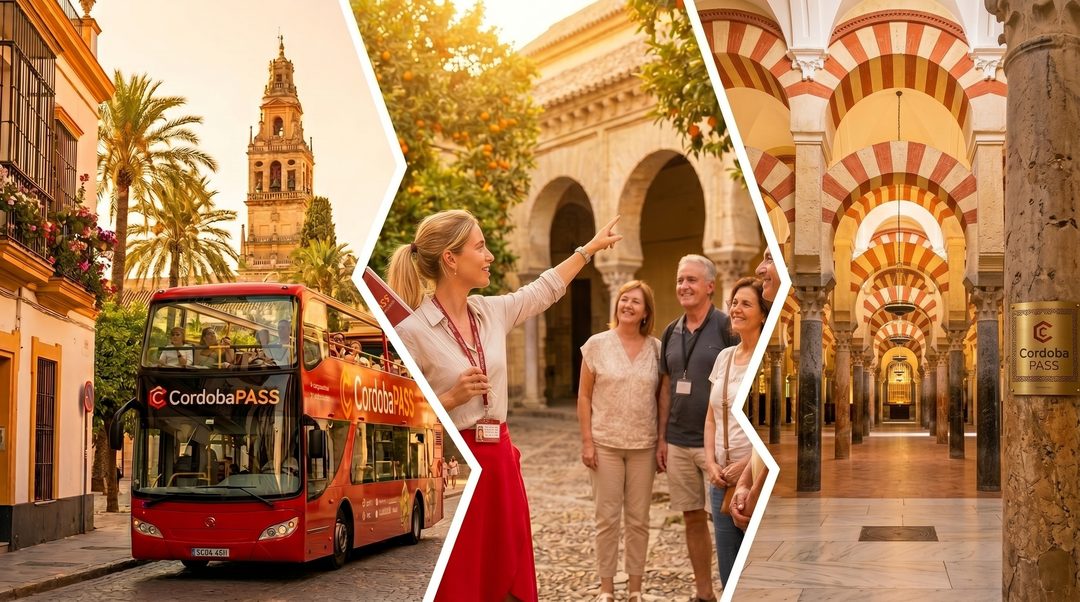
Illustrative image: a guide with a group next to the tourist bus and the Mosque-Cathedral.
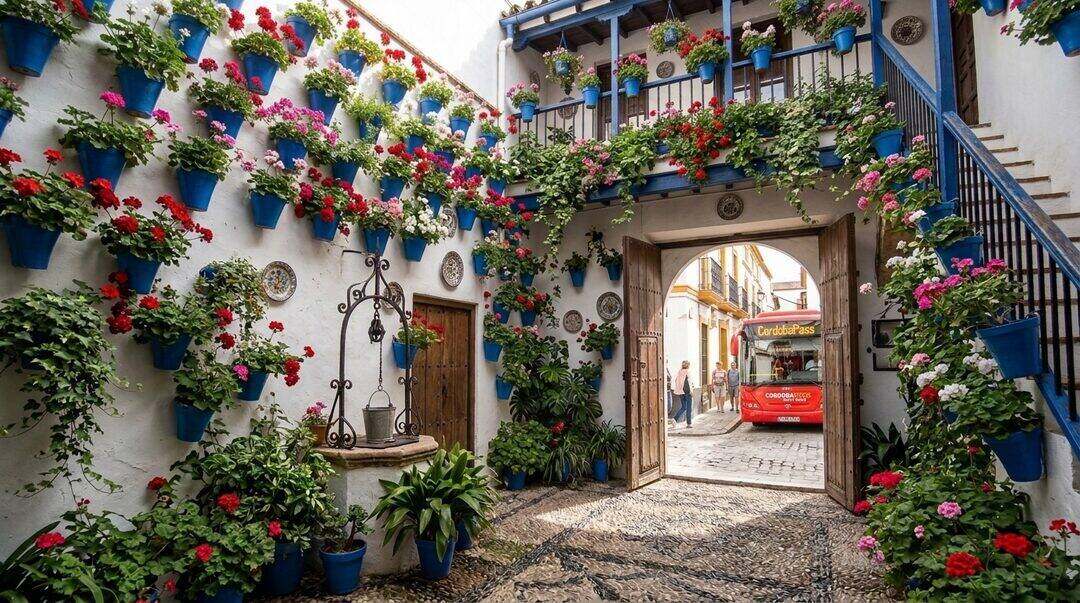
Illustrative image: a courtyard in Córdoba with the tourist bus in the background.
Interactive map of the tourist bus areas
Informational map prepared by CordobaPASS with the areas and places the service passes through; it does not show the exact location of the stops or the bus’s operating route. Please note that the route may change without notice.
Practical tips for getting the most from the bus
- One ticket, two lines: the ticket lets you hop on and off freely at all stops during its validity and switch between the blue and red lines at the connection stops.
- Audio guide in 11 languages on board.
- Guided walking tour included: the operator includes a walking tour of the Jewish Quarter with the ticket (check the details of your ticket to see what it includes).
- Free cancellation up to 24 hours before the chosen travel date, according to the operator’s current policy.
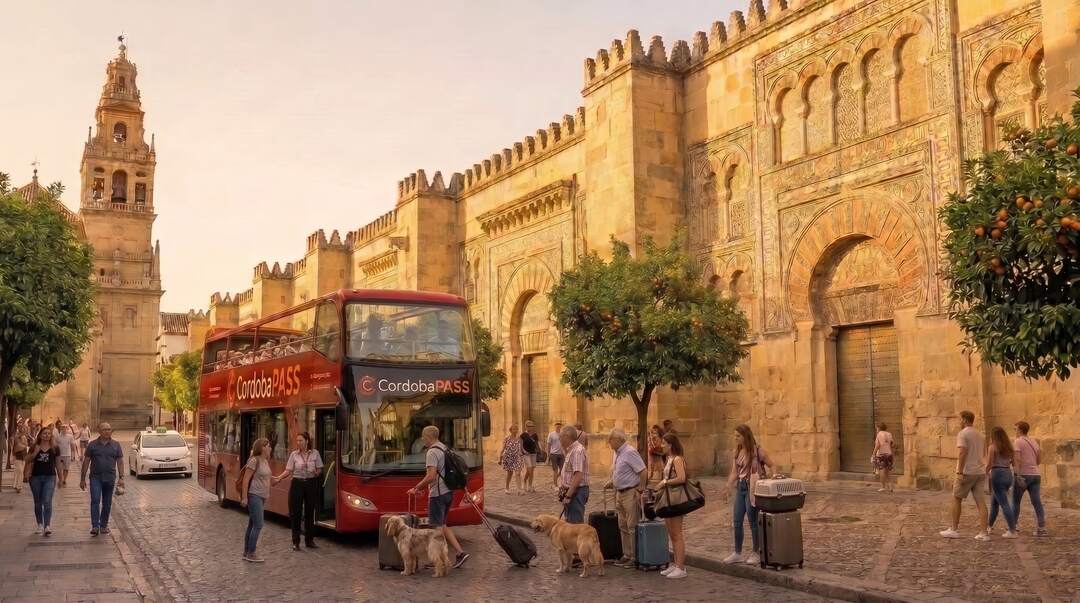
- Dogs: allowed in a carrier, according to the operator’s conditions.
- Routes, stops, frequencies and timetables may vary: they are subject to the operator’s current operations, which publishes its notices on its website.
Frequently asked questions about the tourist bus areas
Does the tourist bus go to Medina Azahara?
No. The two lines run around the city of Córdoba; Medina Azahara is on the outskirts and requires specific transport.
Can I use the same ticket on both lines?
Yes: the ticket is valid for both lines and you can switch between them at the five shared connection stops.
Which line should I choose if I only have half a day?
The Blue Route concentrates the monuments of the historic centre (Mosque-Cathedral, Alcázar, Jewish Quarter). If you have time left over, the Red Route completes the panoramic view and the northern neighbourhoods.
Where does the route start?
The red line starts at the Panorámica del Río and the blue one in the area of the Caliphal Baths-Alcázar, although with the ticket you can get on at any stop, subject to current operations.
Book your tourist bus and see all the areas of Córdoba
At CordobaPASS we handle the visits of thousands of customers every year, and we know well what works when combining the bus with tickets and guided tours. If you have questions about which option fits your trip, write to us at info@cordobapass.com.