
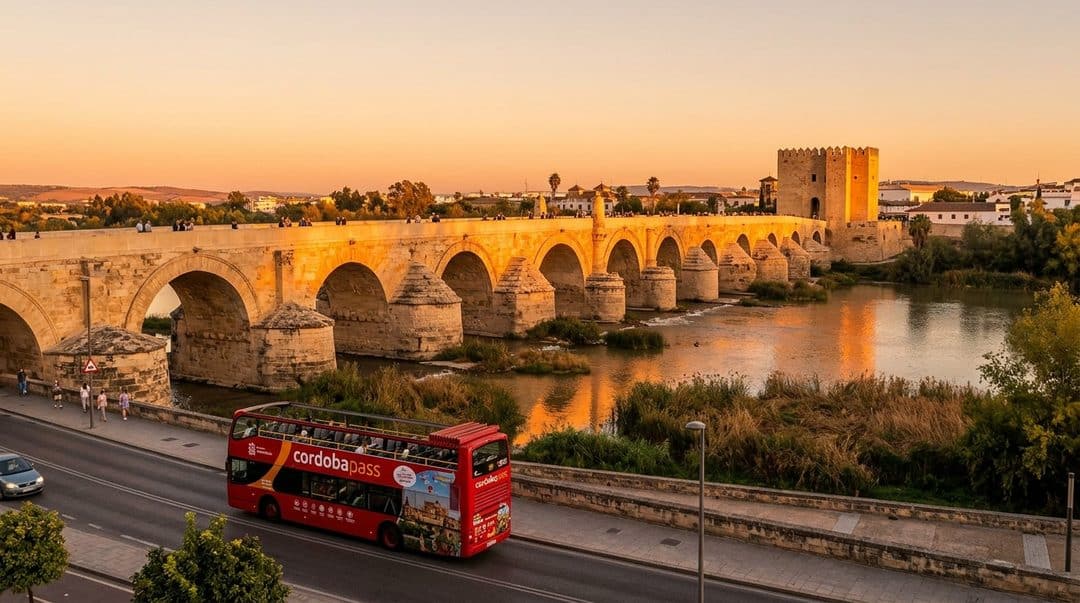
The bridge that has linked Córdoba for two thousand years
Can you cross the Roman Bridge in Córdoba for free? Yes: it is a pedestrian bridge that is open to the public at all times, and crossing it on foot is one of those experiences no traveller should miss. Together with the Mosque-Cathedral, the Puerta del Puente and the River Guadalquivir, it forms, according to Turismo de Córdoba, one of the city’s most beautiful views, especially at sunset.
In this article, you’ll find out about its history, what to see at each end, a map showing its location and how to include it in an organised tour of Córdoba with local guides.
History of the Roman Bridge in Córdoba
According to the official information from Turismo de Córdoba, the bridge was built in the 1st century BC and has undergone several renovations throughout history: the structure visible today is mainly medieval, and the most recent work dates from 1876. It consists of sixteen arches, four of which are pointed and the rest semicircular.
In the centre of the parapet stands a sculpture of Saint Raphael, the city’s patron saint, a 16th-century work by Bernabé Gómez del Río, before which many locals pause to pray. The bridge links the historic centre, at the foot of the Mosque-Cathedral, with the other side of the Guadalquivir, and forms part of the historic centre of Córdoba, a UNESCO World Heritage Site.
What to see on the Roman Bridge and in the surrounding area
The walk across the bridge is short, but there are several points of interest:
- Puerta del Puente: the triumphal arch providing access to the bridge from the historic centre, opposite the Mosque-Cathedral.
- Sculpture of Saint Raphael: halfway along the bridge, with its candles and flowers, this is one of the most characterful spots on the bridge.
- Torre de la Calahorra: the fortress that marks the southern end of the bridge. Today it houses the al-Andalus Living Museum and a terrace offering views of the whole complex.
- The views: the silhouette of the Mosque-Cathedral against the river is one of Córdoba’s classic photographic subjects, and at sunset the light bathes the stone of the bridge and the monument in a golden glow.
Location map of the Roman Bridge
The Roman Bridge crosses the Guadalquivir to the south of the historic centre; its northern end is on Avenida del Alcázar, s/n, at the foot of the Mosque-Cathedral and Córdoba’s Jewish Quarter. Here is a map showing its location:
Visit the Calahorra Tower
At the end of the bridge, the Calahorra Tower is open every day as the Living Museum of al-Andalus. According to the official website of the Calahorra Tower (accessed on 16 November 2026), opening hours are from 10.00 to 19.00 in October and from March to May, from 10.00 to 18.00 from November to February, and from 10.00 to 14.00 and from 16.30 to 20.30 from June to September. General admission costs €4.50 (€3.00 for concessions and €2.00 for those born or resident in the province of Córdoba) and includes access to the terrace and an audio guide in Spanish, English, French, German, Italian and Arabic. Address: Puente Romano, s/n, 14009 Córdoba.
How to include the bridge in an organised tour
The Roman Bridge is free to visit and takes ten minutes to cross, but getting the most out of it is easier with an organised tour. With the Córdoba tourist bus (a 48-hour ticket with unlimited hop-on, hop-off stops), you can explore the city in comfort: according to the operator City Sightseeing, its two routes cross the river, offering views of the Roman Bridge from the bus itself, and the ticket includes a free guided walking tour of the Jewish Quarter and the Axerquía, the neighbourhood that opens up just as you cross the bridge towards the Mosque.
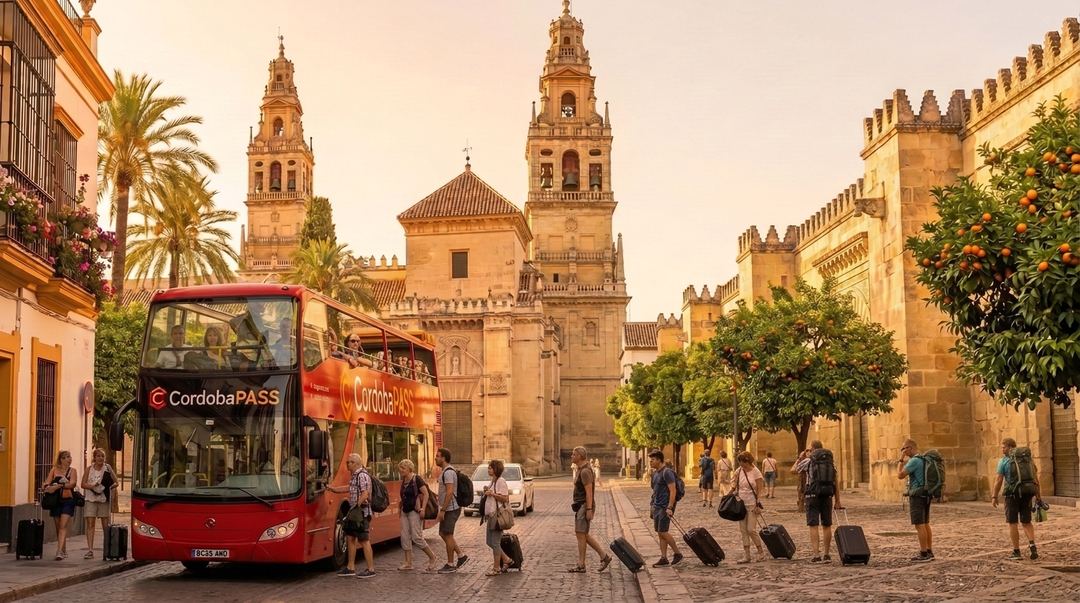
You can also combine a walk across the bridge with a visit to the Mosque-Cathedral by choosing the sightseeing bus option that includes entry to the Mosque. What’s included varies depending on the ticket, so check the details of each option when booking.
Book your organised tour of Córdoba

The Calahorra Tower, at the southern end of the Roman Bridge.
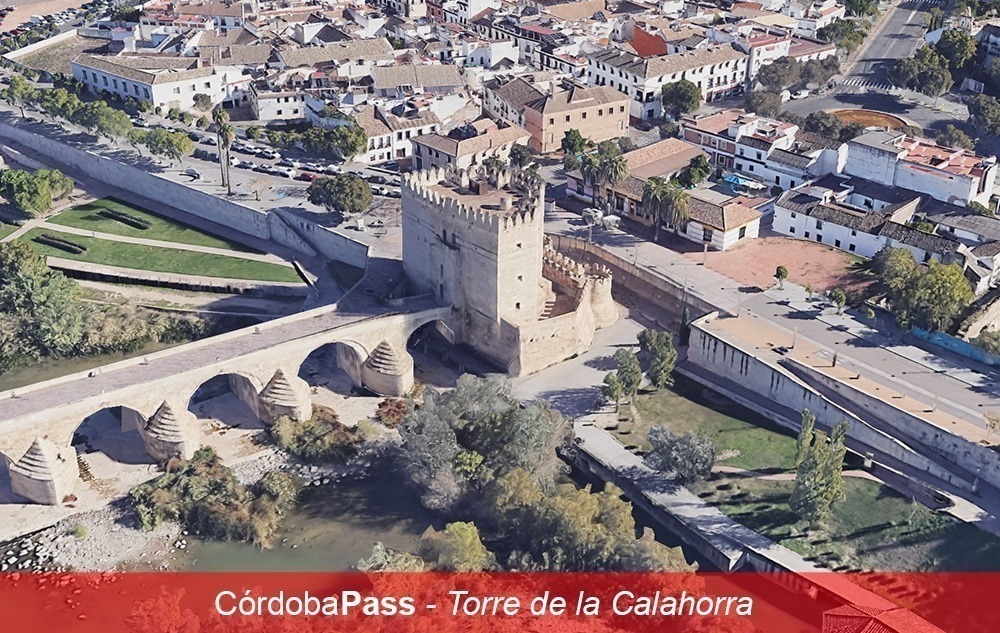
The Calahorra Tower, seen from the area of the Roman Bridge.
Tips for visiting the Roman Bridge
- Go at sunset: Córdoba Tourism highlights this time of day as the most special, when the last rays of the sun bathe the whole area in a golden glow.
- Wear comfortable shoes: the surface is made of flagstones and cobblestones, and you’ll want to carry on walking through the Jewish Quarter afterwards.
- Cross over and come back: the view of the Mosque-Cathedral changes completely from the side of the Calahorra Tower.
- Combine the sights: the Puerta del Puente, the Mosque-Cathedral and the Jewish Quarter are just a short walk from the northern end of the bridge.
- Book guided tours and tickets in advance: this way you can choose from the available dates and times for each activity.
Frequently asked questions about the Roman Bridge in Córdoba
Is it free to cross the Roman Bridge in Córdoba?
Yes. The bridge is for pedestrians only and is freely accessible at any time of day; there is no admission charge and no closing time. Only the Calahorra Tower, at its southern end, charges an admission fee as it is a museum.
How many arches does the Roman Bridge have?
According to the official Córdoba Tourism information sheet, the bridge has sixteen arches: four pointed arches and the rest semicircular. Although its origins date back to Roman times (1st century BC), the current structure is mainly medieval.
What can you see from the terrace of the Calahorra Tower?
From the tower’s terrace, you can enjoy a panoramic view of the bridge, the River Guadalquivir and the silhouette of the Mosque-Cathedral. According to the museum’s official website, access to the terrace is included in all admission prices.
How do you get to the Roman Bridge in Córdoba?
The bridge is at the foot of the Mosque-Cathedral, so you can walk there from anywhere in the historic centre. Depending on the operator, both routes of the Córdoba tourist bus cross the river next to the bridge, so you’ll also be able to see it from the bus.
Conclusion
The Roman Bridge in Córdoba is much more than just a crossing over the Guadalquivir: it is living history, a natural viewing platform overlooking the Mosque-Cathedral and the gateway to the Jewish Quarter. Cross the bridge at sunset, climb the Calahorra Tower and round off the day with a guided tour of the historic centre.
Would you like to organise your visit before you arrive? With CordobaPASS, you can book the sightseeing bus, guided tours and tickets to the main monuments all in one go.